The 2026 RMD Strategy Guide: Stop Taking the Cash
The Old Advice Is Dead
For years, the standard RMD advice was simple: take the cash, pay the tax, move on. In 2026, that approach leaves real money on the table.
Two developments have changed the calculus. First, the One Big Beautiful Bill Act (OBBBA), signed July 4, 2025, permanently extended lower tax brackets and introduced a new senior bonus deduction — both of which interact directly with RMD planning. Second, 2026 Medicare IRMAA surcharges increased approximately 9%, making the $218,000 joint income threshold more consequential than ever.
Wealth retention in 2026 is not about account balances. It is about managing modified adjusted gross income.
What the OBBBA Changed for Retirees
Permanent Tax Brackets
The OBBBA eliminated the uncertainty that had plagued long-range retirement planning since 2017. Lower tax brackets are now permanent, giving retirees a stable runway for Roth conversions, withdrawal sequencing, and multi-year income planning. Strategies that previously carried legislative risk can now be modeled with confidence.
The New Senior Bonus Deduction
Starting in 2025, taxpayers over 65 receive an additional standard deduction of $6,000 per person ($12,000 for a qualifying couple). This phases out between $75,000 and $175,000 for single filers and $150,000 and $200,000 for joint filers.
This creates a hidden cost to large RMDs. A distribution that pushes MAGI above the phase-out range does not just generate ordinary income tax — it simultaneously eliminates up to $12,000 in deductions. Every unnecessary dollar of taxable income in the phase-out zone costs more than its face value.
RMD Age Remains Unchanged
The OBBBA did not alter RMD starting ages. Required distributions begin at 73 for those born before 1960, and at 75 for those born in 1960 or later. What changed is the planning context around those distributions.
The In-Kind Advantage
How It Works
Most retirees take their RMD as cash: the custodian sells holdings and deposits the proceeds. The in-kind alternative transfers the actual securities from your IRA to a taxable brokerage account. Your tax obligation is identical — you owe ordinary income tax on the fair market value of the distribution either way. What changes is everything that follows.
The Cost Basis Reset
This is the core benefit. When shares transfer from an IRA to a taxable account, their cost basis resets to fair market value on the transfer date. Future appreciation is then taxed at long-term capital gains rates — 0, 15, or 20 percent — rather than as ordinary income at rates up to 37 percent.
A practical example: you hold shares currently trading at $150 inside your IRA. You take them as an in-kind RMD and pay ordinary income tax on $150 per share — the same tax you would have owed on cash. Those shares now sit in your brokerage account with a $150 cost basis. If they rise to $200 and you sell a year later, that $50 gain is taxed at capital gains rates, not ordinary income rates. Every dollar of future appreciation has been permanently reclassified into the most tax-favorable treatment available.
Note that the transfer resets the holding period clock. To qualify for long-term capital gains treatment, you must hold the transferred shares in the taxable account for more than one year before selling.
Maintaining Market Exposure
The in-kind approach also solves a practical problem: you do not have to sell a position you want to keep. Taking a cash RMD during a market downturn forces you to lock in losses. Taking the same position in-kind satisfies your RMD requirement while keeping the investment intact — with future recovery taxed at preferential rates.
To execute, contact your IRA custodian, specify that you want the RMD satisfied through an in-kind transfer of particular securities, and ensure you have an existing taxable brokerage account (ideally at the same institution) to receive them.
The Math of the IRMAA Cliff
What IRMAA Actually Costs in 2026
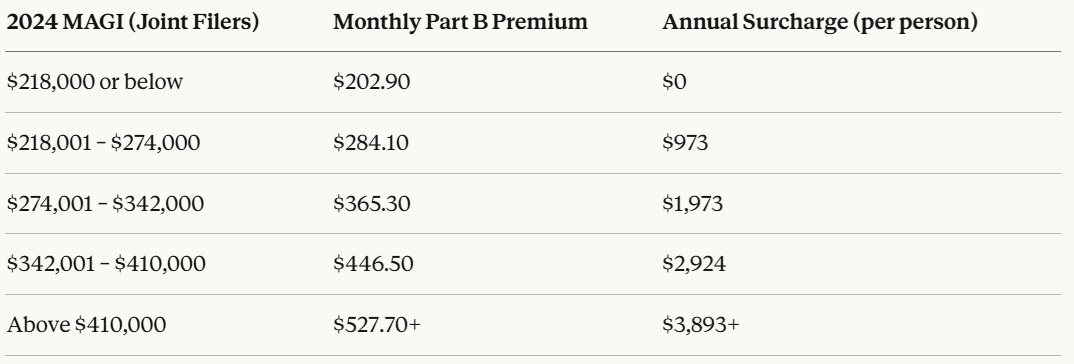
The Income-Related Monthly Adjustment Amount is a Medicare premium surcharge triggered when MAGI exceeds certain thresholds. In 2026, those thresholds increased approximately 9% — and the surcharges themselves follow a cliff structure, meaning one dollar over a threshold triggers the full penalty for that tier.
For married couples filing jointly, the 2026 Part B IRMAA brackets based on 2024 MAGI are:
Source: Centers for Medicare & Medicaid Services, 2026 IRMAA brackets.[1]
Part D adds a further surcharge on top of plan premiums. For a couple where both spouses are on Medicare, crossing from the first bracket to the second costs nearly $2,000 per year — triggered by a single dollar of excess income.
The Two-Year Lookback
IRMAA is calculated using your tax return from two years prior. Your 2026 Medicare premiums are based on your 2024 income. This means actions taken in 2026 affect 2028 premiums, not current ones. Retirement income planning is always a two-year forward projection, and failing to account for the lookback is one of the most common — and expensive — mistakes retirees make.
Tools to Stay Below the Threshold
Qualified Charitable Distributions
The QCD is the most powerful and most underused MAGI management tool available to retirees. IRA holders who are 70½ or older can direct up to $111,000 per person directly from their IRA to a qualified charity. The distribution counts toward the RMD requirement but is excluded from taxable income and, crucially, from MAGI.
Unlike a charitable deduction, which only helps if you itemize, the QCD exclusion reduces MAGI directly. A couple directing $20,000 in combined QCDs toward their favorite charities may reduce joint MAGI by $20,000, protecting the senior bonus deduction and potentially staying below the IRMAA threshold — without changing their effective charitable giving at all.
Roth Conversion Timing
With brackets now permanent, the pre-RMD years are a meaningful window for Roth conversions. Reducing the pre-tax balance in traditional IRAs during years 65 to 72 directly reduces future RMD amounts, lowering MAGI in every subsequent year. The tradeoff is paying tax on the conversion now — but at known, permanent rates, against a future of potentially larger and more disruptive mandatory distributions.
Each conversion must be modeled against the senior bonus deduction phase-out, Social Security taxability thresholds, and IRMAA brackets simultaneously. The interactions are real, and a conversion that looks straightforward in isolation can produce compounding costs across all three.
Critical Takeaways
The OBBBA's permanent brackets provide planning certainty not seen in nearly a decade — use it for multi-year Roth conversion and withdrawal sequencing strategies.
In-kind RMD distributions reset cost basis to fair market value, converting future share appreciation from ordinary income rates to preferential capital gains rates.
The $218,000 joint IRMAA threshold is a cliff, not a slope. One dollar over triggers nearly $2,000 in annual Part B surcharges per couple. Part D adds more.
The two-year IRMAA lookback means 2026 income planning affects 2028 premiums. Plan forward, not just for the current year.
QCDs up to $111,000 per person satisfy RMD requirements while being excluded from MAGI — making them the most efficient tool for retirees near IRMAA thresholds who also have charitable intent.
The OBBBA's $6,000-per-person senior bonus deduction phases out in a MAGI range many retirees occupy, making every dollar of avoidable taxable income more expensive than it appears.
Manage MAGI, Not Just Balances
The retirees who retain the most wealth in 2026 are not necessarily those with the largest accounts. They are the ones who recognize that IRMAA, income taxes, and the senior bonus deduction all run through the same number — modified adjusted gross income — and manage it accordingly.
Taking distributions in-kind instead of cash, directing charitable giving through QCDs, and using Roth conversions strategically before RMD age are not complex maneuvers. They are deliberate, legal, and available to any retiree willing to plan two years ahead rather than reacting at filing time.
The OBBBA gave retirees a stable tax environment and a new deduction worth protecting. The strategies that capitalize on both start with understanding your MAGI, knowing where the cliffs are, and building a distribution plan designed to stay on the right side of them.
This article is for educational purposes only and does not constitute personalized tax or financial advice. Consult a qualified tax professional or financial advisor before implementing any strategies described here.
Sources
[1] Centers for Medicare & Medicaid Services, 2026 Medicare Parts B & D Premiums, cms.gov
[2] Kiplinger, 2026 IRMAA Brackets, kiplinger.com
[3] Phillips Lytle LLP, One Big Beautiful Bill Act SECURE Act Updates, phillipslytle.com
[4] Morningstar, Should You Take Your RMDs In Kind?, morningstar.com
[5] Charles Schwab, Taking In-Kind Distributions from Your IRA, schwab.com