⚡ Life Stage Guide

Retirement Planning in Your 40s

Your 40s are typically your highest-earning decade — and your last chance to course-correct without radical sacrifices. Whether you're on track or behind, this guide covers exactly what to prioritize, what to change, and what the numbers actually mean.

📅 Updated April 2026⏱ 13 min read✍️ Plootus Research Team🎯 Ages 40–49
Salary saved by age 40
Salary saved by age 50
$23,500
2026 401(k) employee contribution limit
20 yrs
Until typical retirement

What Your 40s Really Mean for Retirement

Your 40s are a financial inflection point. For most Americans, this decade brings peak income, peak expenses (mortgage, kids, aging parents), and a growing sense of urgency about retirement. Here's the critical math: every extra $1,000/year you save in your 40s is worth roughly $4,000–$5,500 at retirement (at 7% returns over 20 years). That's still powerful compounding.

The good news: people who are behind in their 40s can close the gap dramatically. The bad news: they need to act decisively. A 45-year-old contributing 20% of a $100,000 salary can still accumulate over $700,000 in additional retirement assets by 65.

If you're behind on savings, your 40s strategy is different from your 30s strategy. The focus shifts from "building good habits" to "maximizing every tax-advantaged dollar." Contribution limits, asset allocation, and employer match optimization become critical.
#1
Max the Match
Non-negotiable. Every unmatched dollar is money left on the table.
#2
Audit Your Fees
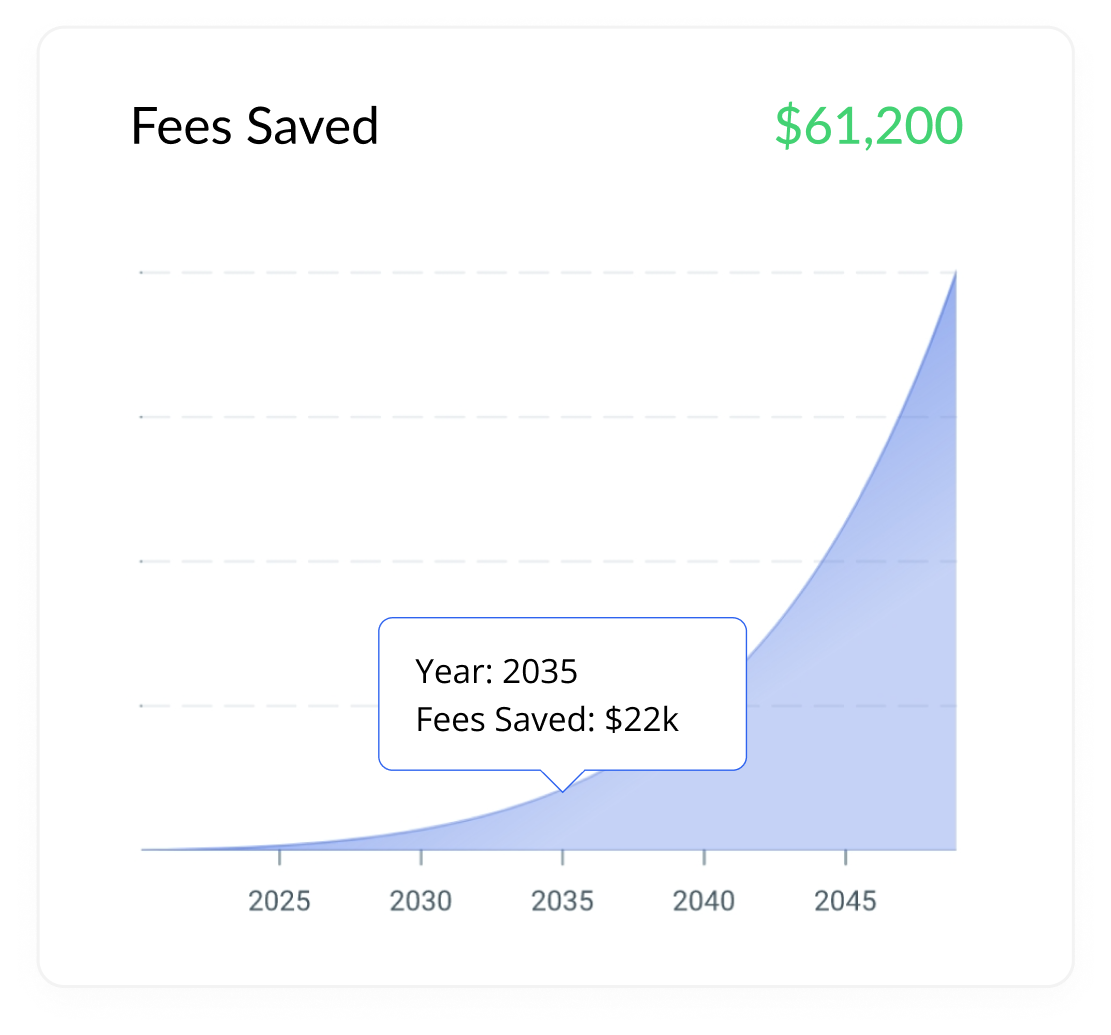
High-fee funds cost $100K+ over 20 years. Switch now — not later.
#3
Know Your Number
Calculate your retirement target and gap. You can't close a gap you haven't measured.

Retirement Savings Benchmarks for Your 40s

Here's where Fidelity's salary-multiple benchmarks say you should be through your 40s. If you're below these, you'll find a catch-up plan in the next section.

AgeFidelity BenchmarkIf You Earn $80KIf You Earn $110KIf You Earn $150K
403× salary$240,000$330,000$450,000
433.5× salary$280,000$385,000$525,000
454× salary$320,000$440,000$600,000
485× salary$400,000$550,000$750,000
506× salary$480,000$660,000$900,000

The median 401(k) balance for Americans aged 45–54 is approximately $87,000 (Vanguard 2025) — far behind these benchmarks for most income levels. You're in the majority if you're behind. The question is how aggressively you respond.

🚨 Reality check: If you're significantly below the 3–4× benchmark at 40–45 and you don't make a change, you're on track for a retirement that's heavily dependent on Social Security — which averages just $1,907/month in 2026. That's survivable but not comfortable.

How to Catch Up If You're Behind

The most powerful levers for catching up in your 40s:

💰 Max Contributions Now

$23,500/year into 401(k)

If you're behind, you need to prioritize retirement savings over everything except match capture. At $23,500/year for 20 years with 7% returns, you'd add ~$1.04M — without a penny of current savings.

📈 Backdoor Roth IRA

$7,000/year more — even at high income

If your income exceeds Roth IRA limits, use the Backdoor Roth strategy. Contribute to a non-deductible Traditional IRA and convert to Roth. Clean up prior IRA balances first to avoid the pro-rata rule.

🏢 After-Tax Mega Backdoor Roth

Up to $46,500 more (if your plan allows)

If your 401(k) plan allows after-tax contributions and in-service withdrawals, you can contribute up to $46,500 more annually in after-tax dollars and convert to Roth. A powerful but underused strategy.

🏥 HSA Investing

$8,550 family / $4,300 individual — invest it all

If you have an HDHP, max your HSA and invest every dollar. Pay medical costs out-of-pocket now, save receipts, and reimburse yourself tax-free in retirement. The triple tax advantage is unmatched.

Asset Allocation in Your 40s

Your 40s are where asset allocation decisions start to really matter. You're still 15–25 years from retirement, but the runway is shorter — a 5-year bear market in your late 40s is more impactful than one in your 30s.

AgeAggressiveModerate (Recommended)Conservative
4090% stocks / 10% bonds80% stocks / 20% bonds65% stocks / 35% bonds
4585% stocks / 15% bonds75% stocks / 25% bonds60% stocks / 40% bonds
4980% stocks / 20% bonds70% stocks / 30% bonds55% stocks / 45% bonds

At 40–45, most investors should still lean toward equity-heavy allocations. The historical data is clear: over 15+ year horizons, stocks have never underperformed bonds. Your bigger risk in your 40s is not having enough growth, not volatility.

International Diversification

Many Americans are significantly underweight in international stocks. A common guideline is 20–40% of your equity allocation in international funds. This reduces single-market risk and captures growth in faster-growing economies. Target: a low-cost total international index fund (expense ratio under 0.10%).

Don't panic-sell during downturns. The single biggest mistake 40-somethings make is moving to cash after a market drop. Studies consistently show that missing the 10 best trading days in a decade — which almost always follow the worst days — cuts long-term returns nearly in half.

Tax Optimization in Your 40s

At peak earnings, tax strategy becomes increasingly valuable. Every dollar you reduce in taxable income is worth 22–32 cents in immediate savings, plus decades of compounding on those retained dollars.

Pre-Tax 401(k)

Reduce taxable income by up to $23,500

If you're in the 24–32%+ bracket, Traditional 401(k) contributions provide immediate, significant tax relief. This frees up cash flow to invest more elsewhere.

HSA Triple Advantage

Deductible + tax-free growth + tax-free withdrawals

No other account offers three tax benefits. HSA funds invested in index funds grow tax-free and can be withdrawn tax-free for any medical expense in retirement — which are substantial.

Tax-Loss Harvesting

Turn losers into tax savings

In taxable accounts, systematically sell investments at a loss to offset capital gains elsewhere. A disciplined harvesting strategy can add 0.5–1.0% to after-tax returns annually.

Roth Conversion Planning

Convert in low-income years

If you have a low-income year (job transition, sabbatical), it's an opportunity to convert Traditional IRA dollars to Roth at a lower rate — locking in tax-free growth for the remaining decades.

Competing Financial Priorities in Your 40s

Your 40s often involve the most expensive financial pressures of your life. Here's the priority framework:

PriorityDecisionWhy
1stEmergency fund (3–6 months)Without this, any shock raids retirement accounts with penalties
2nd401(k) up to full employer matchInstant 50–100% return — best investment available to you
3rdMax HSA (if HDHP-eligible)Triple tax advantage + healthcare costs explode in retirement
4thPay off high-interest debt (above 7%)Guaranteed 7%+ return beats expected market return
5thMax IRA / Roth IRA ($7,000)More tax-advantaged space, more investment flexibility
6thMax 401(k) to $23,500Maximize tax-deferred compounding
7th529 / college savingsAfter retirement is funded — students can borrow, you cannot
8thExtra mortgage paymentsAlmost always beats by investing — especially with low-rate mortgages

Your 40s Retirement Checklist

  • ✅ Calculate your retirement number — use the Plootus Retirement Calculator with real spending data
  • ✅ Know your gap: (Retirement number) − (Current savings × growth factor) = how much more you need to save
  • ✅ Contribute enough to 401(k) to capture 100% of employer match
  • ✅ Audit all 401(k) investment funds — switch anything with expense ratio above 0.20%
  • ✅ Max HSA contributions if you have a high-deductible health plan — invest it, don't spend it
  • ✅ Open or max a Roth IRA ($7,000/year) — or use Backdoor Roth if over income limits
  • ✅ Roll over any old 401(k)s from previous employers into a consolidated IRA
  • ✅ Update life insurance — you likely need term life through age 65–70 if you have dependents
  • ✅ Create or update a will, healthcare proxy, and durable power of attorney
  • ✅ Start thinking about long-term care insurance — cheapest to buy in your 40s
  • ✅ Check Social Security earnings record at SSA.gov — ensure your income history is accurate

Frequently Asked Questions

Sources
  • Fidelity Investments — 2026 Retirement Savings Guidelines and Benchmarks
  • Vanguard — How America Saves 2025
  • IRS — 2026 Retirement Plan Contribution Limits (Rev. Proc. 2025-46)
  • Social Security Administration — 2026 Benefit Data
  • Federal Reserve — Survey of Consumer Finances 2022
  • Plootus Research Team — April 2026

More ways to cut costs and grow your wealth!

Plootus collaborates with select platforms to help you compare, save, and manage your money more efficiently.


Disclaimer: Plootus (an SEC-registered investment advisor) may receive compensation for referrals to third-party products and services, listed on our Partners page. These referrals are for informational purposes only and do not constitute an endorsement or recommendation. Plootus has not conducted due diligence on, nor assumes responsibility for, any third-party offerings. Users are encouraged to evaluate these options independently before making any decisions.

Over 60% of Americans say they lack control over their finances.

Plootus gives you a full financial picture to take back control.

App Store
SUBSCRIBE FOR WEEKLY INSIGHTS!

Stay informed with the top 3 things investors need to know this week, plus updates on new features and expert tips.

©2018-2026 Analyze Future LLC | All rights reserved.

InstagramXThreadsYoutubeFacebookLinkedInBlueskyTiktok
Analyze Future LLC (dba Plootus) is a registered investment adviser with the U.S. Securities and Exchange Commission (SEC). Registration does not imply a certain level of skill or training. All research, analyses, tools, and publications on Plootus.com are the proprietary intellectual property of Analyze Future LLC and are protected under applicable copyright and intellectual property laws. Reproduction, distribution, or commercial use of any content from this site, in whole or in part, without the prior written consent of Analyze Future LLC is strictly prohibited. Research content may be referenced for informational or educational purposes provided that clear attribution is given and a direct link to the original Plootus.com page is included.